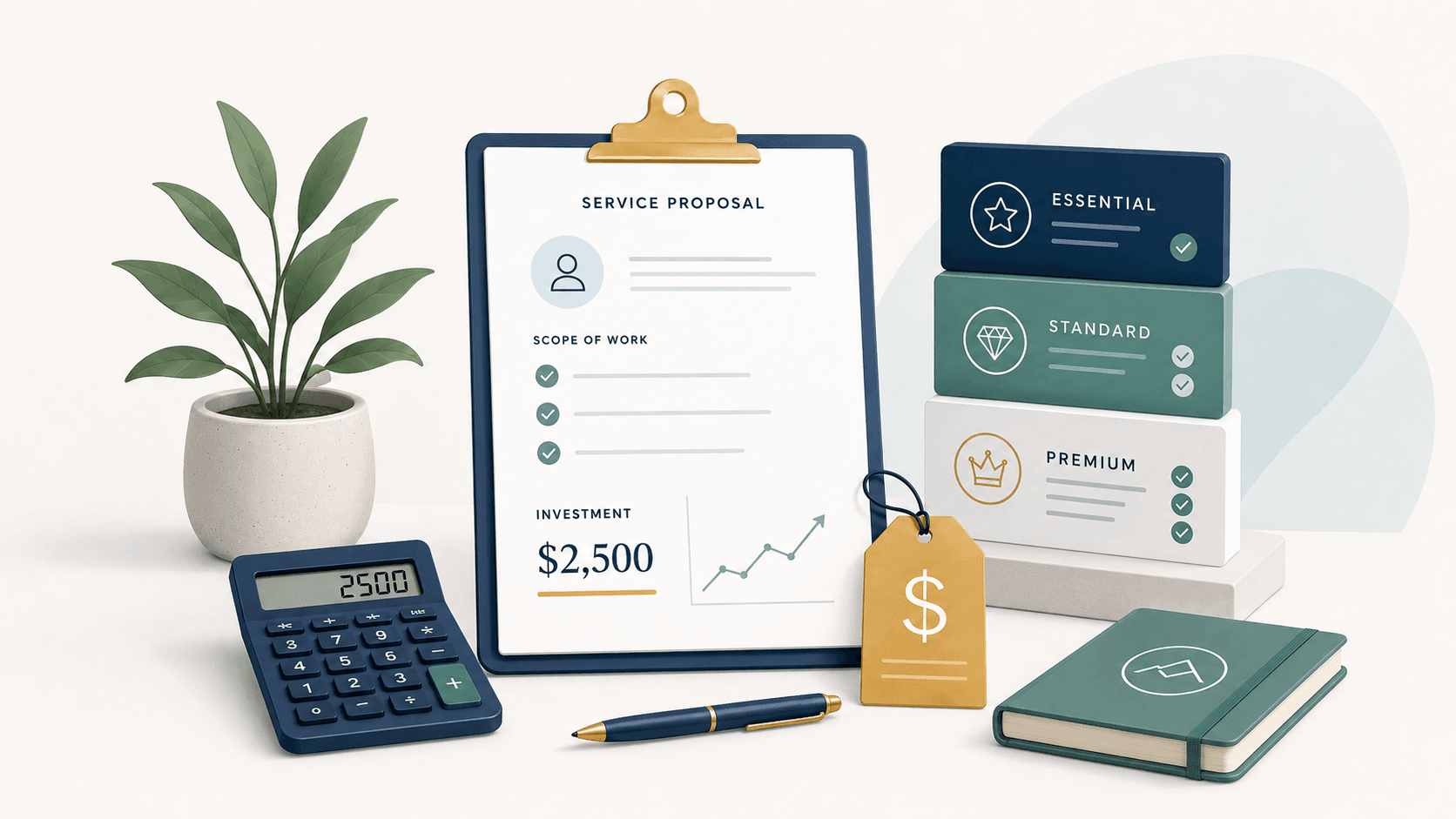
Pricing your first service package can feel awkward.
Charge too much, and you worry no one will book. Charge too little, and you stay busy without making enough money. For many new service business owners, pricing becomes one of the hardest parts of getting started.
The good news is that your first price does not need to be perfect. It needs to be clear, realistic, and profitable enough that you can deliver good work without resenting the job.
Whether you are starting a cleaning business, mobile detailing business, handyman service, pet sitting business, home organizing service, lawn care business, or another local service, the same basic pricing principles apply.
Your price should cover your costs, pay you for your time, leave room for profit, and feel easy for a customer to understand.
Why service package pricing matters
Many new business owners start by charging hourly because it feels simple. But hourly pricing can create problems quickly.
Customers often want to know the total cost before they book. They may hesitate if the final price feels open-ended. Hourly pricing can also punish you as you get faster and more efficient. The better you become, the less you earn per job unless you raise your rate.
That is why service packages are so useful.
A service package gives the customer a clear offer, a clear outcome, and a clear starting price. Instead of saying, “I charge $40 per hour,” you can say, “My starter package includes a 2-hour organizing session, basic sorting, light decluttering support, and a simple action plan for $175.”
That sounds more professional. It is also easier to sell.
Step 1: Define exactly what is included
Before you set a price, define the service.
A vague offer is hard to price. A clear offer is much easier.
Start by answering these questions:
- What problem does this package solve?
- What is included?
- What is not included?
- How long does it usually take?
- What supplies, tools, or travel are required?
- What result should the customer expect?
For example, a basic home organizing package might include one closet, up to three hours of organizing, sorting assistance, light labeling, and a donation pile setup. It might not include hauling items away, purchasing storage containers, or organizing multiple rooms.
A mobile detailing starter package might include an exterior wash, wheels, tires, windows, vacuum, wipe-down, and basic interior clean. It might not include shampooing seats, pet hair removal, paint correction, or engine bay cleaning.
The more specific you are, the easier it becomes to protect your time and avoid scope creep.
Step 2: Calculate your real costs
Your price needs to cover more than your time.
Every service business has costs. Some are obvious, like supplies and gas. Others are easy to forget, like insurance, software, payment processing fees, marketing, vehicle wear, and time spent communicating with customers.
Common service business costs include:
- Supplies and materials
- Tools and equipment
- Gas and travel time
- Insurance
- Software and booking tools
- Payment processing fees
- Website and marketing costs
- Phone, internet, or business apps
- Uniforms or branded materials
- Taxes
- Time spent quoting, scheduling, and following up
For each package, estimate your direct cost per job.
For example, if you run a cleaning business, your supplies may only cost $5 to $15 per visit. But your travel time, gas, laundry, scheduling time, and insurance all still matter.
If you ignore these costs, your price may look profitable when it is not.
Step 3: Decide what your time is worth
New business owners often price based only on what they think customers will pay. That is risky.
You need to decide what your working time is worth before you set your package price.
Start with a target hourly rate. This is not necessarily what you show the customer. It is what you use internally to price your work.
For many local service businesses, your target hourly rate should be higher than a normal employee wage because you are responsible for taxes, expenses, admin time, marketing, insurance, and slow periods.
For example, if you want to earn around $35 per working hour, you may need to charge $50 to $75 per service hour depending on your costs, market, and business model.
Remember: not every hour in your business is billable. You will spend time answering inquiries, creating quotes, driving, buying supplies, updating your website, sending invoices, and following up with leads.
Your pricing needs to account for that.
Step 4: Estimate the time required
Once you know what the package includes and what your time is worth, estimate how long the job will take.
Be honest. New business owners often underestimate the total time involved.
A two-hour job may actually require:
- 15 minutes of messaging before booking
- 20 minutes of travel each way
- 10 minutes of setup
- 2 hours of service work
- 10 minutes of cleanup
- 10 minutes of payment and follow-up
That “two-hour job” may take closer to three hours of your day.
This matters because your service package needs to pay for the full effort, not just the time spent physically doing the work.
Step 5: Use a simple pricing formula
Here is a simple formula for pricing your first service package:
Package Price = Labor + Materials + Travel + Overhead + Profit
Let’s break that down.
Labor is the time required multiplied by your target hourly rate.
Materials include supplies used for the job.
Travel includes gas, mileage, parking, or travel fees.
Overhead is a portion of your business costs, such as insurance, software, marketing, and admin time.
Profit is the extra margin that allows the business to grow.
For example:
| Cost Item | Amount |
|---|---|
| Labor: 3 hours x $50 | $150 |
| Materials | $15 |
| Travel | $10 |
| Overhead allocation | $20 |
| Profit margin | $30 |
| Starter package price | $225 |
This does not mean every package needs to be complicated. But doing the math helps you avoid guessing.
Step 6: Research your local market without copying it
It is smart to look at competitors, but do not blindly copy their prices.
Other businesses may have different costs, different experience, different service areas, different quality, or different goals. Some may be underpricing themselves. Others may be targeting a higher-end customer than you are.
Look for pricing patterns in your area. Search for businesses that offer similar services and pay attention to:
- Starting prices
- Package names
- Minimum job fees
- Travel fees
- Add-ons
- Premium services
- How they describe value
Your goal is not to be the cheapest. Your goal is to be clear, competitive, and profitable.
If most similar services in your area start at $150 to $250, launching at $75 may attract customers quickly, but it may also position your business as low-value. It can be hard to raise prices later if your first customers only booked because you were the cheapest option.
Step 7: Create three simple package options
One of the easiest ways to price your first service offer is to create three package levels.
For example:
Starter Package
Best for small jobs or first-time customers.
Standard Package
Your main offer and best value.
Premium Package
For larger jobs, deeper service, or customers who want everything handled.
This structure works well because it gives customers a choice without overwhelming them.
For a mobile detailing business, the packages might be:
- Basic Wash & Interior Refresh
- Full Interior & Exterior Detail
- Premium Deep Detail
For a home organizing business, the packages might be:
- Single Space Reset
- Half-Day Organizing Session
- Full-Day Home Organization Package
For a handyman business, the packages might be:
- Small Fix Visit
- Half-Day Repair Package
- Full-Day Project Package
Most customers will choose the middle option if it feels like the best value. That means your standard package should be the one you actually want to sell most often.
Step 8: Set a minimum service fee
A minimum service fee protects your time.
Without one, you may end up driving across town for a tiny job that barely covers your gas. Even small jobs require scheduling, communication, travel, setup, and follow-up.
A minimum fee helps you stay profitable.
For example:
- Minimum cleaning visit: $125
- Minimum handyman visit: $150
- Minimum organizing session: $175
- Minimum mobile detailing appointment: $125
- Minimum pet sitting booking: $50
Your minimum should reflect your market, service type, and time commitment.
A minimum fee also makes your business look more professional. It signals that your time has value.
Step 9: Be careful with discounts
Discounts can help you get your first few clients, but they can also create problems.
If you discount too aggressively, you may attract bargain shoppers who are less likely to become long-term customers. You may also train people to wait for lower prices instead of paying your standard rate.
Instead of discounting your core price, consider offering a limited first-client bonus.
For example:
- Free add-on for first-time customers
- Priority scheduling for early bookings
- Small upgrade included for the first 10 clients
- Referral credit after a completed booking
This allows you to create urgency without making your base price look weak.
Step 10: Present your price with confidence
How you present your price matters.
If you sound unsure, customers may question it. If you over-explain, you may make the price feel negotiable.
A simple pricing statement is usually best.
For example:
My starter package is $175 and includes up to three hours of organizing for one small space. That includes sorting support, basic category setup, light labeling, and a simple next-step plan.
Or:
The basic detail package starts at $149. It includes an exterior wash, wheels and tires, vacuum, interior wipe-down, windows, and a final quality check. Heavily soiled vehicles or pet hair removal may require an add-on.
These statements are clear. They explain the value. They also set boundaries.
Step 11: Know when to charge more
Your first price is not permanent.
You should raise your prices when:
- You are consistently booked
- Most leads say yes quickly
- You are getting referrals
- You have improved your process
- Your costs have increased
- Jobs are taking longer than expected
- You are attracting clients who want more premium service
A good rule of thumb: if nearly every customer says yes without hesitation, your price may be too low.
You do not need to double your prices overnight. Small increases are fine. You might raise a package from $149 to $169, then to $189 as demand grows.
Step 12: Avoid common first-time pricing mistakes
The biggest pricing mistake is trying to win every customer.
You do not need every person to say yes. You need enough of the right customers to build a profitable business.
Avoid these common mistakes:
- Charging only for labor and forgetting expenses
- Copying the cheapest competitor
- Not setting a minimum fee
- Including too much in the package
- Failing to charge for travel
- Offering unlimited revisions or unlimited time
- Discounting before the customer even objects
- Keeping prices the same after demand increases
The goal is not to be expensive for no reason. The goal is to build a business that can survive.
Example: Pricing a first service package
Let’s say you are starting a home organizing business and want to offer a “Single Space Reset” package.
The package includes one closet, pantry, laundry room, or small storage area. It includes sorting, category setup, light labeling, and a simple maintenance plan.
You estimate:
| Pricing Factor | Estimate |
|---|---|
| Service time | 3 hours |
| Admin and follow-up | 30 minutes |
| Travel | 30 minutes |
| Target hourly rate | $50 |
| Supplies | $10 |
| Business overhead allocation | $20 |
| Profit buffer | $25 |
Your internal cost calculation looks like this:
| Cost Item | Amount |
|---|---|
| 4 total hours x $50 | $200 |
| Supplies | $10 |
| Overhead | $20 |
| Profit buffer | $25 |
| Package price | $255 |
You may choose to market this as:
Single Space Reset — starting at $249
That price is clear, professional, and grounded in your actual costs.
Should you show prices on your website?
In most cases, yes.
Showing starting prices can help qualify leads and reduce back-and-forth messages. It also builds trust because customers know what to expect before they contact you.
You do not need to list every possible price. You can use phrases like:
- Starting at $149
- Packages from $199
- Most projects range from $250 to $600
- Custom quote required for larger jobs
This gives customers a useful estimate while still protecting you from unusual or oversized projects.
For service businesses, clear pricing can be a competitive advantage. Many local businesses make customers call just to get basic information. If your website is clearer, you may win more serious leads.
Final pricing checklist
Before you publish your first package, make sure you can answer these questions:
- Is the service clearly defined?
- Do I know what is included and excluded?
- Have I accounted for supplies, travel, admin time, and overhead?
- Does the price pay me fairly for my time?
- Is there a minimum fee?
- Do I have boundaries for add-ons or larger jobs?
- Can I explain the value in one or two sentences?
- Would I feel good delivering this service at this price?
If the answer is yes, your price is good enough to start.
You can adjust as you learn.
The bottom line
Pricing your first service package is not about finding the perfect number. It is about creating a clear offer that covers your costs, pays you fairly, and makes sense to the customer.
Start with the math. Package the service clearly. Set a minimum. Avoid racing to the bottom. Then improve your pricing as you gain experience.
A strong service business is not built by being the cheapest. It is built by being clear, reliable, and profitable enough to keep serving customers well.
If you are starting a local service business, Starter Business Kits gives you the practical templates you need to launch faster, including pricing worksheets, service menu templates, quote forms, client trackers, website copy planners, and launch checklists.